Market participants currently imply a 1.9% probability for "Will Russia capture all of Kupiansk by June 30?".
The YES side is priced at 1.9¢, and the NO side at 97.9¢.
Liquidity is low, supported by $116,265 in recent trading activity.
Last Updated: 2026-06-15T12:02:13.062Z
Current Market Pricing
YES Price
1.9¢
Bullish probability pricing
NO Price
97.9¢
Bearish probability pricing
Prediction markets currently imply a live probability of approximately 1.9%.
Market Structure
Probability
1.9%
Spread
0.002
Liquidity
Low
Volume (24h)
$116,265
Markets with tighter spreads and higher liquidity generally indicate stronger trader participation and more efficient price discovery.
Resolution Criteria
This market will resolve to “Yes” if, according to the ISW map, Russia captures the entirety of Kupiansk by June 30, 2026, at 11:59 PM ET.
Kupiansk will be considered captured if the entirety of the municipality is shaded red on the ISW map (https://storymaps.arcgis.com/stories/36a7f6a6f5a9448496de641cf64bd375) by the resolution date. If the area is not shaded red by June 30, 2026, 11:59 PM ET, the market will resolve to “No”.
The territory of the municipality is shaded in light grey and is distinguished from bordering municipalities such as "Moskovka" with a darker grey line. If all area within the municipality is shaded in red, but the shading does not precisely match up with the border, such that there is a tiny amount of grey along the border of the city, this will still qualify for a "Yes" resolution.
For any change on the ISW map to qualify for this market’s resolution, the relevant shading indicating Russian control must persist through the next full ISW daily update cycle. If ISW skips a day, shading must persist until the next finalized ISW update is published, regardless of the date. Any continuous shading which reflects either “Assessed Russian Control”, “Assessed Russian Advance In Ukraine”, or “Assessed Russian Gains in the Past 24 Hours” will qualify. “Assessed Russian Infiltration Areas in Ukraine” will not qualify.
For the purpose of this market, areas separated from the main municipality through a darker grey line, such as in the southeast of Kupiansk (https://polymarket-upload.s3.us-east-2.amazonaws.com/h-b99a52275d.png), will not count towards the municipality.
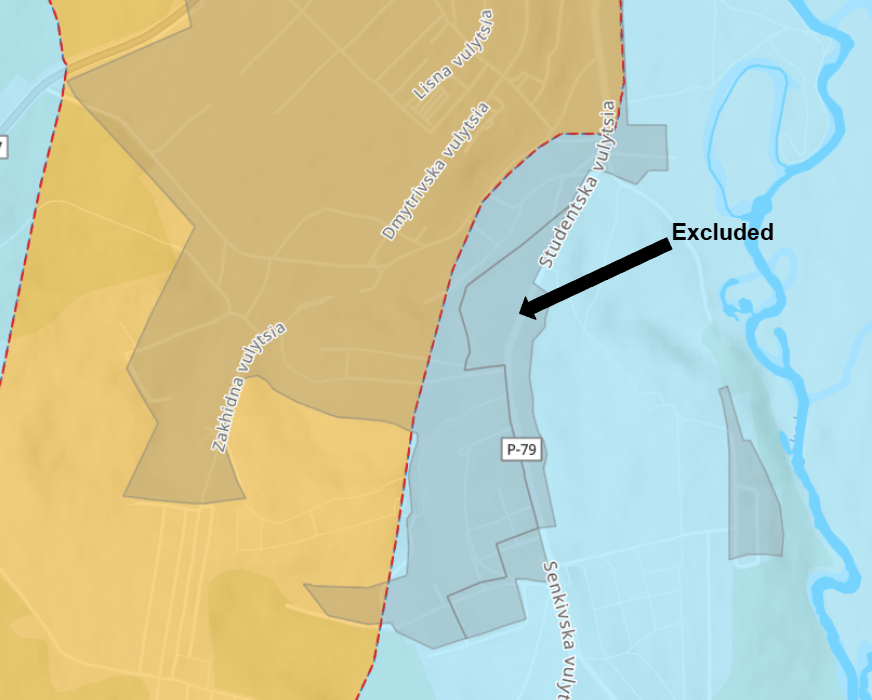
Once Russia captures Kupiansk, any subsequent loss of control will not be considered towards the resolution of this market.
Kupiansk Location: https://polymarket-upload.s3.us-east-2.amazonaws.com/Kupiansk+location.jpeg
Location on Google maps: https://maps.app.goo.gl/ngCjTi39GSjbzaC46
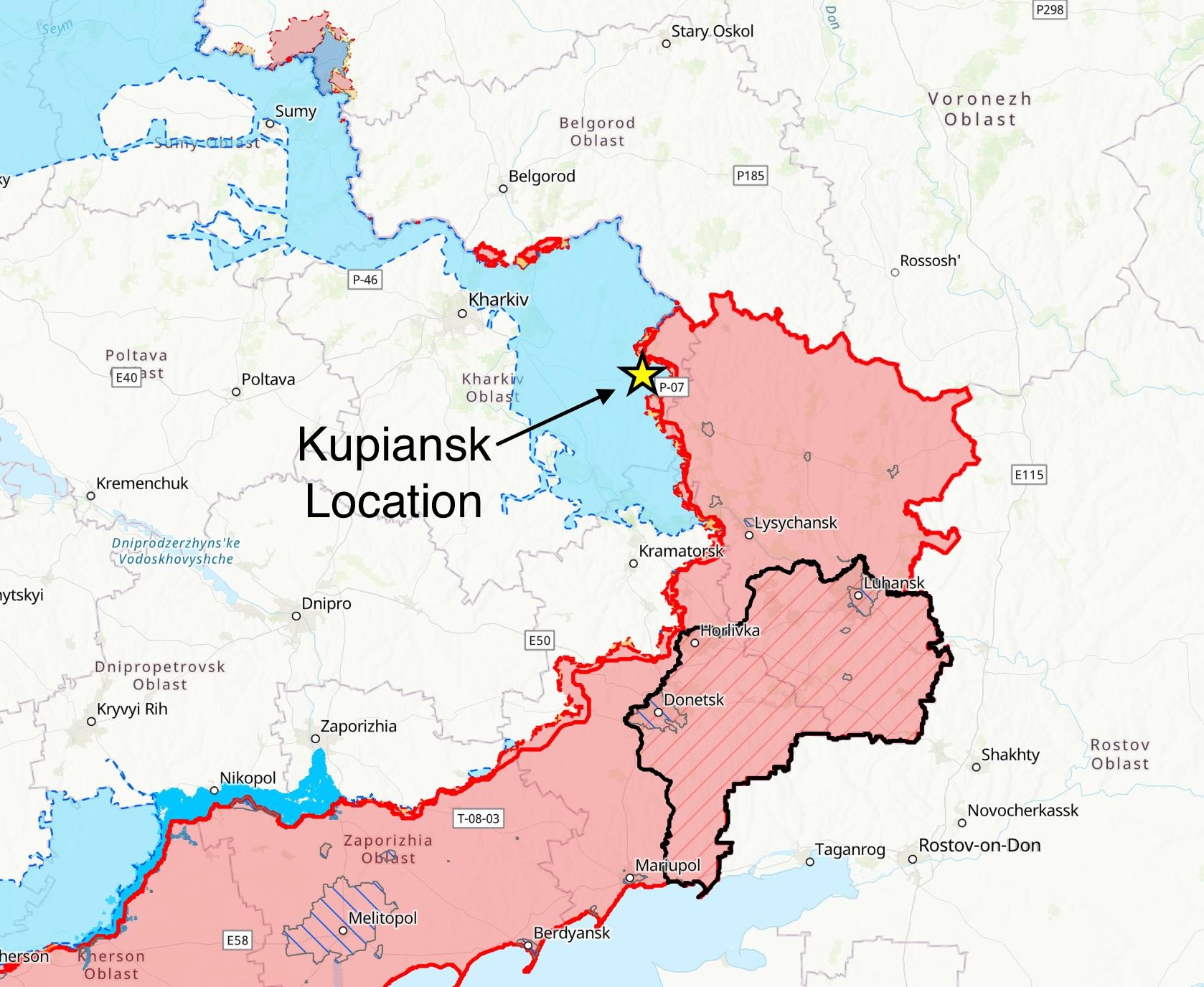
The primary resolution source for this market will be the ISW Ukraine map. If the ISW map is rendered unavailable, information from DeepStateMap (https://deepstatemap.live/) may be used. If information from both the ISW and DeepStateMap are rendered permanently unavailable, a consensus of credible reporting may be used.
Note: Any temporary glitches or errors in the map which will not be considered.
If Russia comes into control of this territory as a result of a negotiated settlement, this will qualify for a 'Yes' resolution, regardless of whether it is shaded red in the ISW map. An announcement of a negotiated settlement that gives Russia de jure control will not qualify. Actual control must be established.
Market Interpretation
Prediction markets operate as continuously updating consensus systems where price is not prediction — it is compressed belief under liquidity pressure.
At any moment, pricing reflects aggregated trader positioning across:
Current pricing structure implies:
- YES trades near 1.9¢
- NO trades near 97.9¢
- Implied probability clusters around 1.9%
This is not static forecasting — it is a continuously reweighted probability surface that reacts to incoming information in real time.
The scalability of modern consensus infrastructure is increasingly proven by its ability to absorb massive, compressed global events without liquidity fragmentation. Major tournament calendars and high-frequency international events no longer act as isolated speculative anomalies, but as key proof points for real-time risk repricing.
For instance, during major 2026 international sports cycles like the FIFA World Cup, single-contract market pools routinely scale past $1.8B+ in individual execution volume. These intense thematic clusters show how retail sentiment and automated liquidity parameters map parallel team outcomes, host-nation positioning, and short-cycle variables under a unified probability framework.
Rather than diluting macro-financial tracking, these high-volume event spikes stress-test the underlying execution layers—demonstrating that order-book depth can handle sudden, multi-million dollar data swings within minutes of real-world resolution.
This infrastructure turns global cultural phenomena into highly structured financial telemetry, proving that prediction networks can ingest, sort, and settle billions in fast-moving capital alongside core geopolitical and economic indexes.
Platforms such as Polymarket and Kalshi now function as high-throughput probability engines, with cumulative sector trading volume exceeding $150B+ and sustained monthly flow consistently pacing between $20B and $31B throughout 2026 trading cycles.
By mid-2026, prediction market activity hit record nominal velocity, with peak months like May printing over $31.2B in combined volume. This institutionalized liquidity split saw Kalshi routing approximately $17.9B in transactional flow while Polymarket's international engine anchored $8.8B in parallel event-driven allocations.
Market structure has therefore shifted far beyond episodic retail speculation into continuous global liquidity formation, where geopolitical negotiations, tariff regimes, AI competition, corporate milestones, sovereign risk, and financial expectations are repriced in real time.
This transition has transformed prediction markets into always-on consensus infrastructure capable of absorbing information flows faster than traditional polling systems, legacy forecasting pipelines, institutional research desks, and mainstream media narratives.
The modern prediction market stack increasingly behaves like a distributed probabilistic intelligence layer for global events rather than a niche speculative product category.
Market Metadata
- Market ID:
will-russia-capture-all-of-kupiansk-by-june-30 - Snapshot Timestamp: June 15, 2026 at 08:01 AM
- Category Class: Implied Probabilisty
- Signal Type: binary outcome probability surface
Trade This Market on Polymarket
Monitor live probability shifts, trader positioning, and real-time market consensus directly on Polymarket.
Explore More →